


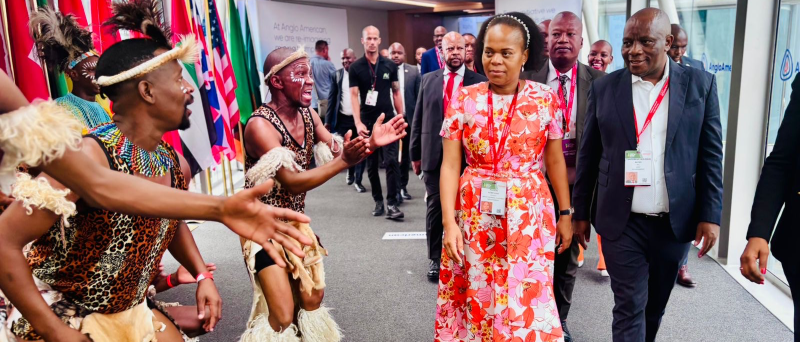
The Limpopo Provincial Government secured a series of strategic Memoranda of Agreement (MOAs) with mining companies that are set to significantly upgrade and rehabilitate key road infrastructure across the province’s mining corridors.
Led by Limpopo Premier Dr. Phophi Ramathuba, the Limpopo delegation used Africa’s premier mining investment platform not only to position the province as a destination for capital, but to conclude concrete infrastructure partnerships aimed at resolving long-standing road deterioration linked to heavy mining haulage and recent flood damage.
Central to the agreements is collaboration with the Roads Agency Limpopo (RAL), which will oversee the rehabilitation, upgrading and maintenance of strategic provincial routes. In mining-intensive districts such as Sekhukhune and Lephalale, road networks have borne the brunt of sustained industrial traffic, placing pressure on provincial budgets and affecting both freight efficiency and community mobility.
Among the headline agreements is a partnership between RAL and five mining companies operating in the Sekhukhune District to upgrade and maintain Road D212 — a critical economic artery serving both mining operations and surrounding communities. A separate agreement involving Kwethu (Pty) Ltd focuses on the rehabilitation of key routes in the western limb corridor. In total, six MOAs were concluded during the Indaba, collectively designed to improve road safety, reduce logistics bottlenecks and extend the lifespan of strategic transport infrastructure.
For Limpopo’s economy, the implications are far-reaching. Road infrastructure is the backbone of the province’s mining, agricultural and tourism sectors. By leveraging private-sector participation in maintaining routes directly impacted by mining activity, the provincial government is easing fiscal pressure while strengthening the reliability of freight corridors essential for export competitiveness.
The agreements signal a more structured public–private partnership model in which infrastructure responsibility is shared, and economic externalities are proactively managed.
Beyond infrastructure, Premier Ramathuba’s engagements at the Indaba built on the R170 billion in investment pledges secured at the 2025 Limpopo Investment Conference. Bilateral meetings with mining executives and investors focused on expanding beneficiation capacity, supporting localisation of supply chains and integrating renewable energy solutions into mining operations.
The province’s strategic message was clear: Limpopo intends to move up the value chain, ensuring that its mineral wealth translates into industrial development, job creation and inclusive growth.
Discussions also emphasised supplier development and skills transfer. Mining stakeholders signalled strengthened collaboration with local enterprises and training institutions to expand artisanal, engineering and technical capacity within host communities. This alignment between capital investment and human capital development is expected to support long-term sustainability in key mineral belts.
The MOAs signed at the Mining Indaba reflect a shift from policy dialogue to implementation-driven partnerships. By anchoring mining investment within a framework that addresses infrastructure resilience and community impact, Limpopo has demonstrated a pragmatic approach to balancing economic growth with public accountability.
As projects move from agreement to execution, the success of these partnerships will depend on coordinated oversight and measurable delivery. However, the outcomes secured in Cape Town underscore a decisive step toward modernising Limpopo’s transport network and reinforcing its position as one of South Africa’s most strategic mining provinces.

Copyright © Leaders Journal | Designed by: Leopash Media