



Leadership is evolving. Markets are more volatile, teams are more diverse, and stakeholders are more demanding than ever before. In this environment, instinct alone is not enough. The most effective leaders are intentional students of their craft continually refining how they think, decide, communicate, and execute.
Certain books have endured because they offer more than inspiration. They provide frameworks. Discipline. Structure. Perspective.
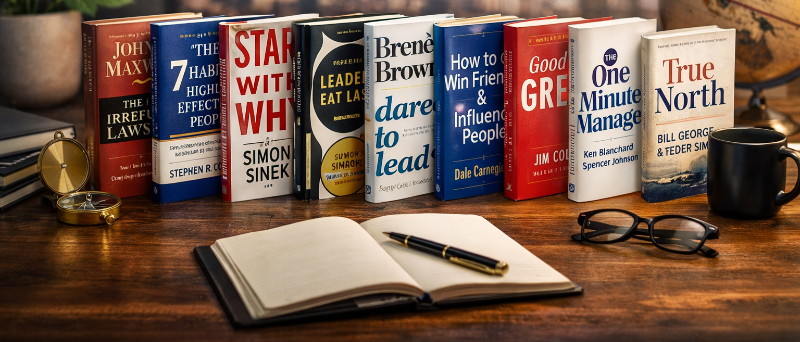
Here are ten leadership works that continue to shape high-performing executives across industries.
1. The 21 Irrefutable Laws of Leadership — John C. Maxwell
Maxwell distills leadership into clear, transferable principles. From influence to legacy, the laws outlined in this book serve as a practical blueprint for leaders at every level. Its enduring value lies in its simplicity timeless concepts that apply whether leading a start-up or a multinational enterprise.
2. The 7 Habits of Highly Effective People — Stephen R. Covey
Covey shifts the focus inward. True leadership effectiveness begins with personal discipline, character alignment, and intentional habits. The book’s structured approach to growth makes it a foundational text for executives seeking long-term impact rather than short-term performance spikes.
3. Start with Why — Simon Sinek
Sinek argues that the most influential leaders begin with clarity of purpose. Organizations that communicate their “why” inspire deeper loyalty and sustained performance. In competitive markets, purpose-driven leadership becomes a differentiator.
4. Leaders Eat Last — Simon Sinek
Expanding on trust and culture, Sinek explores how leaders who prioritize the well-being of their teams create resilient organizations. Psychological safety, not fear, drives sustainable excellence.
5. Dare to Lead — Brené Brown
Brown challenges traditional leadership stereotypes, arguing that courage and vulnerability are strategic strengths. In an era demanding transparency and authenticity, this work reframes what strong leadership truly looks like.
6. How to Win Friends and Influence People — Dale Carnegie
A near-century-old classic that remains profoundly relevant. Carnegie’s insights into human behavior, communication, and influence form the relational backbone of effective leadership. Strategy may win markets, but relationships sustain them.
7. Good to Great — Jim Collins
Based on extensive research, Collins identifies what separates enduring companies from average ones. His concept of “Level 5 Leadership” — humility combined with fierce resolve has become a benchmark for executive maturity and performance.
8. The One Minute Manager — Ken Blanchard & Spencer Johnson
Concise and practical, this book offers actionable management tools: clear goals, immediate feedback, and structured recognition. Its simplicity makes it particularly powerful for leaders building operational discipline within growing organizations.
9. The Five Dysfunctions of a Team — Patrick Lencioni
Through a compelling business fable, Lencioni dissects common team breakdowns absence of trust, fear of conflict, lack of accountability. For leaders committed to building high-performance teams, this work provides a diagnostic framework.
10. True North — Bill George & Peter Sims
Authenticity anchors sustainable leadership. George emphasizes the importance of understanding one’s values, story, and purpose. In times of crisis or scrutiny, leaders grounded in self-awareness make clearer, steadier decisions.
What unites these ten books is not trendiness but durability. Each addresses a core leadership tension: Authority versus influence, Speed versus discipline, Profit versus purpose, Confidence versus humility, Control versus trust.
The most respected leaders understand that growth in responsibility must be matched by growth in self-awareness. They read not merely for motivation, but for refinement.
On the executive bookshelf, these titles represent more than knowledge. They represent commitment to better decisions, stronger cultures, and legacies that endure.

Copyright © Leaders Journal | Designed by: Leopash Media